
Washington’s stunning glaciers, located in the Olympic Mountains, the Cascades, and Mt. Rainer, have existed for thousands of years. Their meltwater helps nourish many animals and plants here, and it keeps us humans alive too! We need it for drinking water, irrigation, and hydropower. But we won’t have it for long, say some, with conversations about climate change’s impact on glaciers circulating the globe.
To begin, let’s talk about climate change. Climate change, predominantly caused by human activity, refers to greenhouse gases forming a “blanket” and trapping heat from the sun in our atmosphere. The main greenhouse gases are carbon dioxide and methane, which are produced from burning fossil fuels. Since the 1800s, humans have been using fossil fuels like coal, oil, and gas to power things such as vehicles and buildings. Because we have been using them for more than 200 years, they have built up heavily in the atmosphere, and our planet is now around 1.44°C warmer than it was prior to the Industrial Revolution. This connects back to glaciers because this heat is making the glaciers we have in Washington State melt too fast.
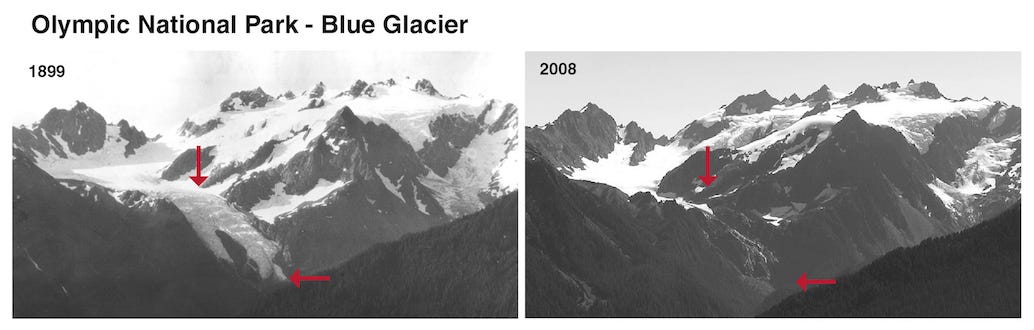
Source: U.S. National Park Service
This point is emphasized when we look at Blue Glacier in Olympic National Park. It is a 2.6-mile-long glacier which, according to a researcher, is equivalent to over 20 trillion ice cubes. Each year, 50-70 feet of snow falls on Mount Olympus, and a lot of this feeds Blue Glacier and many more. The picture above shows how much snow it has lost in the span of around 110 years. This massive amount of snow that is now gone could have been an environment for other animals or a resource for us. Higher temperatures are reaching higher elevations, and as a result, precipitation that could have been falling as snow is now falling as rain. However, this is not only affecting Blue Glacier; many others, such as Lillian Glacier, are also experiencing this loss of snow and ice. Below is a picture of Lillian Glacier over the span of 105 years.
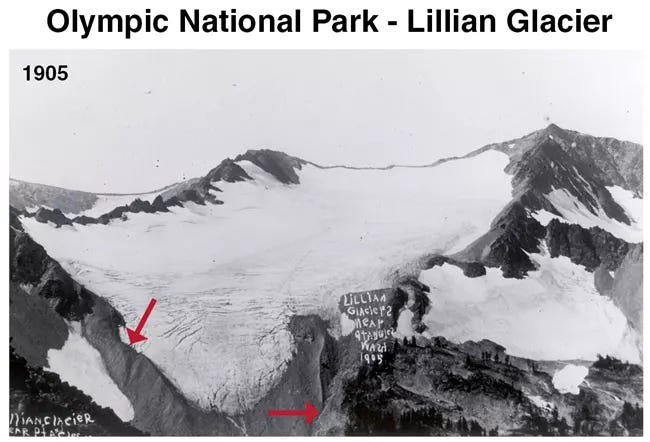
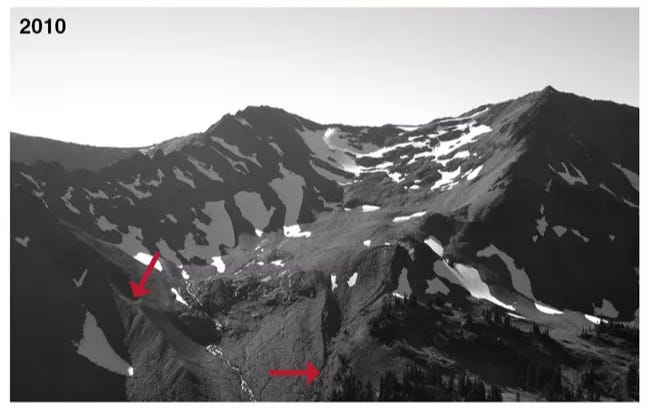
Source: U.S. National Park Service
This brings up a question many people have–what can WE do? Although it seems hard, we have many different routes we can take, like cutting emissions by using renewable energy such as wind or solar power instead of fossil fuels, which release methane. According to NASA, one molecule of methane traps more heat than one molecule of carbon dioxide, but it lasts much less time, with a lifespan of just 7-12 years in our atmosphere. These greenhouse gases are the primary source of climate change, and this is one reason that what could have been snow is now falling as rain. Another thing we can do, which seems more doable for many people, is to reduce the amount of energy we use on a daily basis. Switching to greener transportation, like biking, walking, or carpooling, can also help reduce methane emissions.
To conclude, glaciers are vital parts of Washington’s ecosystems. As the photos of Blue Glacier and Lillian Glacier show, greenhouse gases are heating our planet and making ice melt too fast. By switching to clean energy and making greener choices for transportation–like biking, walking, or saving power–we can help slow down climate change. Taking action now protects the beautiful glaciers of Washington and keeps them safe for generations to come.
Author: Sree Kriti Mamillapalli
SOURCES:
What Is Climate Change? | United Nations
Glaciers and Climate Change - Olympic National Park (U.S. National Park Service)
Methane - Earth Indicator - NASA Science
What You Can Do About Climate Change — Transportation | US EPA